

Introduction
Environmental, social, and governance (ESG) refers to a set of measurable factors used to assess how responsibly an organisation operates and how well it is positioned for long-term value creation. Understanding the process of ESG reporting has become increasingly important as businesses move beyond profit-only thinking toward sustainable, accountable growth.
Originally gaining traction in investment circles, ESG has since evolved into a mainstream business priority. It examines how organisations manage environmental impact, social responsibilities, and governance practices, offering a more holistic view of risk and opportunity.
Today, knowing what ESG is and why ESG reporting matters helps stakeholders, from investors to the wider public, better assess business value and responsibility. It now serves as a central framework for evaluating how organisations strengthen resilience, build trust, and sustain long-term performance in a complex operating environment.
Key Takeaways:
- The key to understanding what ESG is lies in recognising it as a framework that evaluates environmental, social, and governance performance beyond financial metrics
- ESG supports long-term value creation by identifying risks and opportunities early
- Strong governance underpins effective environmental and social outcomes
- ESG reporting builds trust, improves transparency, and supports compliance
- Businesses of all sizes, including SMEs, are increasingly expected to adopt ESG practices.
Understanding ESG at a High Level
What is ESG?
At its core, ESG refers to a structured approach used to evaluate how organisations manage sustainability, ethical responsibility, and long-term risk. Instead of focusing solely on financial outcomes, ESG considers how companies operate within environmental limits, treat people and communities, and govern themselves responsibly.
1. The Environmental Pillar (E)
The environmental pillar focuses on how an organisation impacts and manages the natural environment. It is often the most visible aspect of ESG, especially as climate-related issues gain global attention.
Key Environmental Factors:
- Climate change exposure and carbon emissions
- Energy efficiency and use of renewable energy
- Water consumption and responsible water management
- Waste reduction, recycling, and circular economy practices
- Biodiversity protection, deforestation, and land use
These ESG factors help organisations evaluate how their operations interact with natural systems and regulatory expectations.

Environmental performance has direct operational and financial implications. Climate-related risks can disrupt supply chains and affect asset values. Increasing regulatory pressure, particularly around environmental compliance, introduces new reporting requirements and potential costs.
At the same time, efficiency initiatives such as reducing energy use can lower operating expenses and drive innovation. Environmental responsibility also shapes brand perception, as customers and stakeholders expect companies to act responsibly.
2. The Social Pillar (S)
The social pillar is also central to understanding what ESG is. It focuses on how an organisation manages relationships with people and communities. This includes how it treats employees, customers, suppliers, and the wider community.
Key Social Factors:
- Employee health, safety, and well-being
- Diversity, equity, and inclusion
- Fair wages, labour standards, and working conditions
- Supply chain responsibility and human rights protections
- Customer safety, data privacy, and product responsibility
- Community engagement and broader social impact
Social factors are increasingly important as talent attraction and retention are closely linked to workplace culture. Organisations with strong social practices are more likely to attract and retain skilled employees.
Apart from internal workforce considerations, social expectations also extend across the value chain. Supply chain failures can lead to reputational damage and regulatory consequences, especially as consumers become more informed and expect accountability from their partners and suppliers.
3. The Governance Pillar (G)
The governance pillar focuses on how an organisation is led, managed, and held accountable. It forms the backbone of ESG ensuring that environmental and social initiatives are implemented effectively.
Key Governance Factors:
- Board structure, independence, and diversity
- Executive remuneration and incentive alignment
- Ethical conduct, anti-corruption policies, and compliance systems
- Shareholder rights and transparency
- Risk management, internal controls, and oversight mechanisms
Strong governance enables effective decision-making and supports long-term thinking. By establishing transparent structures and robust controls, organisations can build trust with investors and stakeholders while ensuring regulatory compliance.
Without strong governance, even well-designed environmental or social initiatives may fail to deliver meaningful outcomes. There may be insufficient oversight, unclear accountability, or inconsistent execution across the organisation.
Together, these pillars form the ESG framework, providing a comprehensive view of how organisations manage risks and opportunities beyond traditional financial metrics.
How Has ESG Evolved?
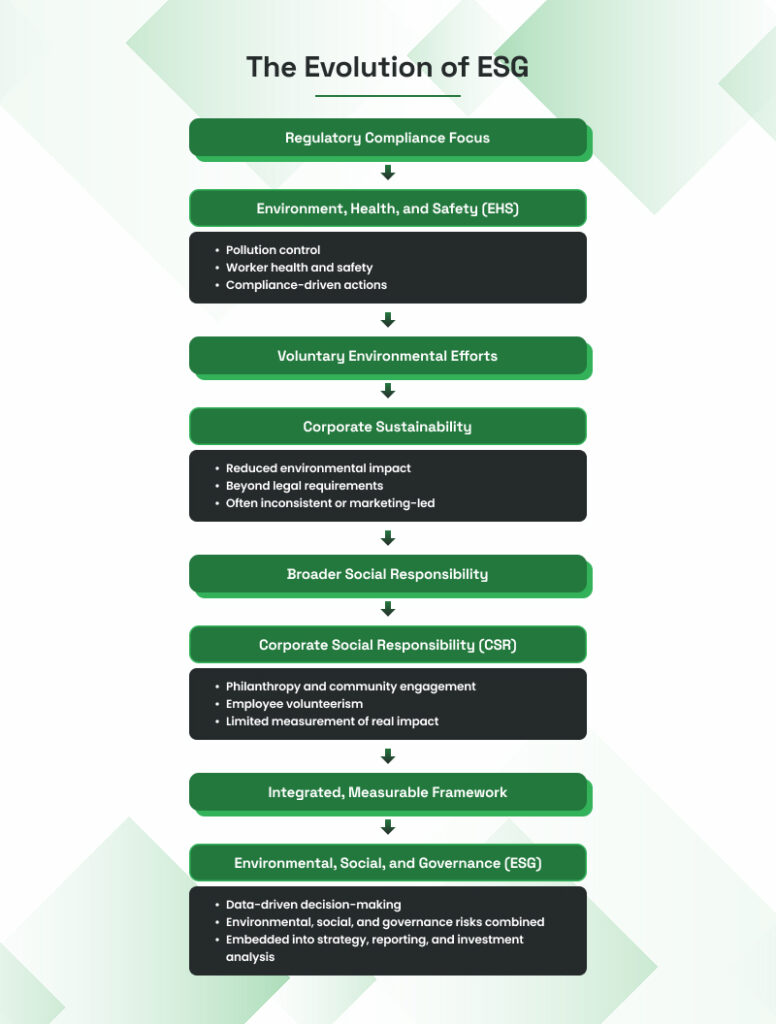
ESG did not emerge in isolation. To fully understand what it is, it is useful to examine how it developed from earlier approaches that addressed environmental and social risks in a more limited, fragmented way. Over time, these frameworks expanded in scope, moving from compliance-driven actions to more strategic and measurable practices.
Environment, Health, and Safety (EHS)
EHS laid the early foundation by focusing on operational risks related to pollution control and worker safety. These efforts were largely driven by regulatory requirements, with organisations aiming to meet minimum legal standards rather than pursue broader sustainability goals.
While EHS helped establish important practices, such as monitoring emissions and improving workplace health and safety, it was often reactive. Companies typically addressed issues only when required, keeping the focus on avoiding penalties.
Corporate Sustainability
Corporate sustainability marked a shift toward more proactive environmental management. Organisations began to look beyond compliance and explore ways to reduce their environmental footprint, such as improving energy efficiency or minimising waste.
However, these initiatives were often voluntary and varied widely in quality and consistency. Without standardised metrics or reporting structures, it was difficult for stakeholders to assess the true impact of these efforts. In some cases, sustainability initiatives were driven more by branding considerations than measurable outcomes.

Corporate Social Responsibility (CSR)
CSR expanded the conversation by introducing social considerations into business practices. Companies began engaging in philanthropy, community programmes, and employee volunteerism, recognising their broader role in society.
While CSR helped raise awareness of social impact, it often lacked clear measurement and accountability. Activities were often disconnected from the core strategy, making them difficult to evaluate or link to long-term performance. As a result, CSR was sometimes perceived as an add-on.
Environmental, Social, and Governance (ESG)
ESG represents the next stage of evolution, combining environmental, social, and governance considerations into a structured, data-driven framework. As a whole, the evolution from EHS to ESG highlights a clear progression from compliance-focused actions to integrated, strategic management of sustainability and governance.
Unlike earlier approaches, ESG integrates measurable outcomes into strategy and reporting. It moves beyond voluntary initiatives toward structured, data-driven decision-making, aligning with modern business expectations and regulatory developments.
The ESG Framework Today: Financial Impact, Reporting Standards, and the Road Ahead
How Does ESG Relate to Financial Performance?
While ESG is often associated with sustainability and ethics, its impact extends directly into how organisations manage risk, allocate capital, and sustain performance over time.
1. Link to Long-Term Value Creation
ESG helps organisations identify structural risks and opportunities that traditional financial metrics may overlook. These include climate-related disruptions, supply chain vulnerabilities, regulatory changes, and shifts in consumer expectations.
By incorporating ESG considerations into strategy, businesses are better positioned to anticipate long-term trends. For example, investing in energy efficiency or responsible sourcing may involve upfront costs. However, it can lead to reduced operating expenses, improved brand trust, and stronger customer loyalty over time.
In this sense, ESG supports more stable and sustainable growth by aligning business decisions with long-term value creation.
2. Risk Mitigation Through ESG Integration
Strong ESG practices serve as practical risk mitigation strategies, helping organisations identify and manage potential issues early. This reduces exposure to operational disruptions, regulatory penalties, reputational damage, and financial risks in the long run.
From an environmental perspective, failing to address emissions or resource usage may result in regulatory penalties or increased costs as policies tighten. Social risks, such as poor labour practices or weak supply chain oversight, can lead to reputational damage and disruption. Governance failures, including weak internal controls or a lack of transparency, may undermine investor confidence and regulatory compliance.
By integrating ESG into core operations, organisations can identify these risks earlier and implement controls to manage them more effectively. This proactive approach reduces the likelihood of unexpected financial losses and supports business continuity.

3. Impact on Cost of Capital and Investor Confidence
Companies with credible ESG performance often attract a broader, more diverse pool of investors, including those focused specifically on sustainability. As awareness of ESG grows, investors increasingly consider ESG data alongside financial metrics when making decisions.
Strong ESG performance can signal lower risk, better management practices, and long-term resilience. This may improve investor confidence and, in some cases, lower the cost of capital. Lenders and financial institutions may also view ESG-aligned businesses as more stable, influencing lending terms and access to financing.
However, it is important to note that ESG does not guarantee immediate financial gains. Often realised over time, the benefits depend on how well they are integrated into business strategy and execution.
Why ESG Reporting Matters
ESG reporting translates strategy into measurable outcomes. It allows organisations to move beyond high-level commitments and demonstrate how environmental, social, and governance efforts are actually implemented and tracked over time. Understanding what ESG is is only the first step. ESG reporting is what makes these efforts visible, comparable, and credible to stakeholders.
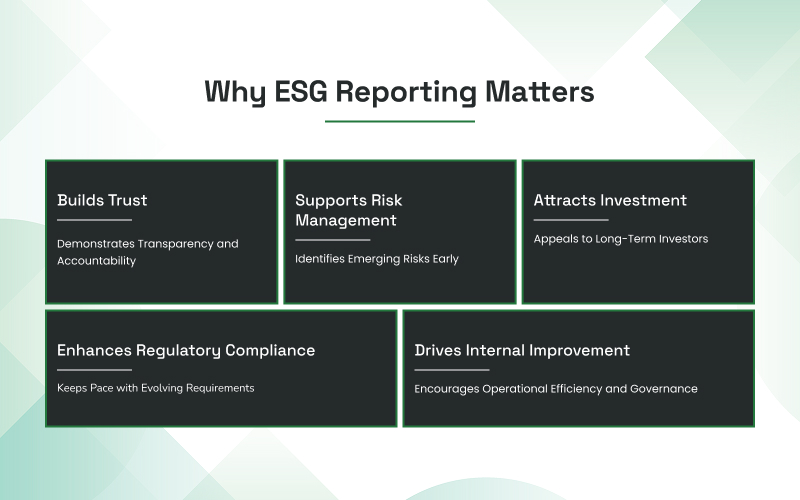
1. Builds Trust: Demonstrates Transparency and Accountability
Clear reporting shows stakeholders how decisions are made and how the organisation is managing its impact. By disclosing both progress and challenges, companies can build credibility with their stakeholders.
Transparency is particularly important in areas such as emissions, labour practices, and governance structures, where stakeholders expect verifiable data. Consistent reporting helps establish trust over time, especially when supported by internal controls or independent validation.
2. Supports Risk Management: Identifies Emerging Risks Early
ESG reporting provides a structured way to identify and monitor risks that may not appear in traditional financial reports. These can include climate-related exposure, supply chain vulnerabilities, or governance weaknesses.
By tracking relevant ESG indicators, organisations can detect early warning signs and take corrective action before issues escalate. This strengthens overall risk management and aligns ESG with broader business resilience.
3. Attracts Investment: Appeals to Long-Term Investors
Investors are increasingly incorporating ESG considerations into their decision-making processes. Detailed and consistent reporting enables them to assess how well an organisation manages long-term risks and opportunities.
Additionally, companies that provide credible ESG disclosures are often viewed as more transparent and better governed. This can improve investor confidence and make the organisation more attractive to funds that prioritise sustainability and long-term performance.
4. Enhances Regulatory Compliance: Keeps Pace with Evolving Requirements
Regulatory expectations around ESG disclosures are becoming more defined, particularly in areas such as climate reporting and governance transparency. ESG reporting supports alignment with these requirements by establishing structured processes for consistent data collection and disclosure.
By adopting a proactive approach, organisations can reduce the risk of non-compliance. At the same time, they can also prepare for future regulatory developments, which are expected to become increasingly stringent.
5. Drives Internal Improvement: Encourages Operational Efficiency and Governance
ESG reporting is not only outward-facing. It also supports internal improvement by highlighting gaps in performance and areas for optimisation.
For instance, tracking energy use or waste generation can reveal inefficiencies that may otherwise go unnoticed. Similarly, reviewing governance structures can lead to stronger oversight and clearer accountability. Over time, these improvements contribute to more efficient operations and better decision-making.
What are the Key ESG Reporting Frameworks and Standards?
ESG reporting relies on both frameworks and standards to ensure consistency, comparability, and credibility across organisations. Understanding ESG principles requires knowing how companies structure their disclosures and measure performance.
Frameworks generally guide what organisations should report, while standards define how information should be measured and disclosed. Together, they help stakeholders interpret ESG performance in a more structured and meaningful way.
1. Global Reporting Initiative (GRI)
The Global Reporting Initiative is one of the most widely adopted reporting frameworks globally. It takes a stakeholder-focused approach, meaning it looks beyond financial performance to consider broader environmental and social impacts.
GRI’s flexibility allows broad adoption across industries, though it may lead to variations in how disclosures are presented. It encourages organisations to disclose how their activities affect areas such as climate, labour practices, and communities. The initiative is useful for companies aiming to communicate their overall sustainability impact to a wide range of stakeholders, including customers, employees, regulators, and the public.
2. Sustainability Accounting Standards Board (SASB)
SASB focuses on industry-specific ESG issues that are financially material to investors. Unlike broader frameworks, SASB identifies the most relevant ESG topics for each industry and provides standardised metrics for reporting. It is often used alongside other frameworks to provide both breadth and depth in ESG reporting.
The standard is particularly useful for organisations seeking to align ESG disclosures with financial performance and investor expectations. By concentrating on financially relevant data, it helps investors better assess risks and opportunities tied to ESG factors.
3. International Sustainability Standards Board (ISSB)
The ISSB represents a significant step toward global standardisation of ESG reporting. Being increasingly adopted or referenced by regulators, it has become an important consideration for companies looking to future-proof their reporting.
The ISSB has introduced IFRS S1 and IFRS S2, which focus on general sustainability disclosures and climate-related information respectively. By standardising how sustainability data is reported, these frameworks also strengthen sustainability report assurance by improving consistency and reliability.
As a result, they aim to create a clear global baseline for ESG reporting, reducing fragmentation across frameworks. This provides organisations with clearer expectations and better comparability across markets.
4. IFRS Foundation
The IFRS Foundation oversees the development of ISSB standards and plays a key role in integrating ESG sustainability reports with traditional financial reporting. This integration reflects a broader shift in how organisations view ESG, treating it as part of overall business performance.
By aligning ESG disclosures with established financial reporting principles, the IFRS Foundation reinforces core ESG principles such as transparency, consistency, and accountability. This helps ensure that sustainability information is not only relevant and reliable, but also decision-useful for investors and other stakeholders.
5. Task Force on Climate-related Financial Disclosures (TCFD)
TCFD focuses specifically on climate-related risks and opportunities. It provides recommendations structured around four core areas: governance, strategy, risk management, and metrics and targets.
Many organisations use TCFD to disclose how climate change may impact their operations and financial performance. Its emphasis on forward-looking information makes it particularly valuable for understanding long-term exposure to climate risks.
Across many jurisdictions, including Singapore, TCFD-aligned disclosures are gaining prominence as regulators move toward more structured reporting expectations. In some cases, organisations are required to incorporate TCFD recommendations into their reporting practices, particularly in areas such as governance, risk management, and climate-related metrics.
6. Singapore Exchange (SGX)
The Singapore Exchange provides sustainability reporting guidance for listed companies, including recommended ESG metrics and mandatory climate disclosures for selected sectors.
SGX requirements reflect local regulatory expectations while aligning with global standards such as TCFD and ISSB. For companies operating in Singapore, these guidelines are essential in shaping ESG reporting practices and ensuring compliance with evolving regulations.

In practice, many organisations use a combination of these frameworks and standards to meet different stakeholder needs. For example, GRI may be used for broader impact reporting, while SASB or ISSB standards provide more investor-focused disclosures.
As ESG reporting continues to evolve, there is a clear trend toward greater alignment and standardisation. For organisations working with accountants in Singapore, this shift simplifies reporting while improving the reliability and comparability of ESG information across organisations and markets.
How to Approach Effective ESG Reporting
Approaching reporting effectively requires a structured process that aligns with business strategy, ensures data reliability, and supports continuous improvement. Reporting functions not only as a communication tool, but also as a framework for managing performance and decision-making.
1. Understand ESG Reporting
Recognise that ESG reporting supports transparency and trust, not just compliance, as it provides stakeholders with visibility into how the organisation manages environmental, social, and governance risks. For businesses working with a small accounting firm in Singapore, this also helps ensure reporting is structured, accurate, and aligned with stakeholder expectations.
2. Identify Material Issues
Focus on ESG topics that are most relevant to your business and stakeholders. Not all ESG issues carry equal importance across industries, so identifying material issues is essential for meaningful reporting. This often involves stakeholder engagement, risk assessments, and industry benchmarking.
3. Choose a Framework
Select reporting frameworks and standards that align with your industry, strategy, and stakeholder expectations. Many organisations adopt a combination of frameworks to address different needs, such as broad impact reporting and investor-focused disclosures.
4. Set a Reporting Plan
Define roles, timelines, and governance structures to support the reporting process. The process typically requires input from multiple departments, including finance, operations, human resources, and compliance. This not only clearly defines ESG but also helps improve coordination and reduce the risk of inconsistent data.
6. Report and Disclose
Prepare clear and structured ESG reports that explain performance, challenges, and how ESG is integrated into business operations. Reports should provide context to help stakeholders understand the organisation’s approach and progress.
7. Improve Continuously
Use insights from reporting, stakeholder feedback, and internal reviews to refine ESG strategy. ESG reporting should not be static. Instead, it should evolve as the organisation grows and as expectations change.
How the Future of ESG Looks
As ESG continues to mature, the focus is shifting toward consistent and decision-useful standards. Regulatory convergence is expected to reduce ambiguity while increasing expectations around data quality and governance.
ESG is also becoming embedded in enterprise risk management, influencing how organisations assess resilience and long-term strategy.
However, one limitation worth noting is that ESG data can still vary in quality and comparability across industries. This means organisations must invest in reliable systems and governance to ensure meaningful reporting.
For SMEs, the real challenge lies in translating ESG into practical actions within limited resources and operational capacity. Implementing ESG effectively often requires guidance from experienced advisors to help integrate ESG considerations into everyday business decisions.
How Credo Assurance Supports Businesses
As a dependable accounting and audit firm in Singapore, Credo Assurance supports businesses in strengthening governance structures, improving reporting discipline, and enhancing the reliability of ESG disclosures.
We provide tailored advisory and audit guidance that helps businesses maintain compliance while supporting sustainable growth. In doing so, we also help organisations better understand what ESG is by translating it into practical actions across financial and operational processes. This includes integrating ESG considerations into day-to-day reporting, alongside assurance services that strengthen reporting accuracy, reliability, and credibility.
Frequently Asked Questions
1. Is ESG only relevant to large or listed companies?
No. While ESG requirements are more formalised for large organisations, SMEs are increasingly expected to adopt ESG practices due to stakeholder and supply chain expectations.
2. How is ESG different from Corporate Social Responsibility (CSR)?
CSR focuses on voluntary initiatives, while ESG is a structured, data-driven framework used to measure performance and risk.
3. Does strong ESG performance improve financial results?
ESG does not guarantee short-term profits, but it supports long-term value through improved risk management, capital access, and trust.
Conclusion
ESG is no longer a peripheral concept. It now helps organisations navigate environmental impact, social responsibility, and governance quality in a structured way. As expectations continue to rise, businesses must move beyond compliance and focus on meaningful integration. This requires clear priorities, reliable data, and strong governance.
For organisations seeking to strengthen their ESG journey, Credo Assurance can provide the expertise and support needed. Our audit and accounting firm helps improve ESG reporting, enhance credibility, and build long-term resilience.
Looking to further explore what ESG is and how it applies to your organisation? Contact us to support your ESG reporting and compliance needs.