

Introduction
Businesses today are expected to operate responsibly alongside achieving financial performance. Increasing scrutiny from investors, regulators, consumers, and employees has shifted expectations towards greater transparency and accountability in how organisations manage environmental and social impact.
In this context, terms such as Corporate Social Responsibility (CSR) and Environmental, Social, and Governance (ESG) are frequently used and often treated as interchangeable. However, CSR and ESG represent different approaches to addressing responsibility, risk, and long-term value creation.
Differentiating the two concepts is therefore essential. A clear understanding helps businesses align strategy, meet stakeholder expectations, and support sustainable, measurable growth.
Key Takeaways:
- CSR and ESG both relate to responsible business practices, but they differ in structure, measurement, and accountability.
- CSR is often values-driven and voluntary, while ESG is more structured, data-led, and connected to risk management.
- ESG frameworks help businesses translate sustainability efforts into measurable sustainability metrics.
- Businesses can use CSR as a foundation before developing a more formal ESG approach.
- Strong reporting, governance, and assurance support help organisations build credibility as ESG expectations evolve.
What CSR and ESG Actually Mean
What Is Corporate Social Responsibility (CSR)?
CSR refers to the way businesses voluntarily incorporate social and environmental considerations into their operations and interactions with stakeholders. Traditionally, CSR has been shaped by a company’s values and its desire to contribute positively to society beyond its core commercial activities.
In practice, CSR initiatives often include community outreach programmes, employee well-being efforts, environmental campaigns, or sustainability-driven product initiatives. These actions are typically designed to strengthen brand reputation, build goodwill, and demonstrate a company’s commitment to broader societal goals.
However, CSR has historically been less structured in measuring outcomes. Many initiatives are communicated through narratives rather than supported by consistent data, making it difficult to assess their long-term impact or compare performance across organisations. As accountability expectations rise, this limitation becomes clearer, especially when stakeholders expect evidence of responsible practices.
What Is Environmental, Social, and Governance (ESG)?
ESG is a more structured and measurable framework for evaluating how organisations manage sustainability, ethical responsibility, and long-term risks. Unlike CSR, ESG is not limited to voluntary initiatives. It is embedded in how businesses operate, report, and are assessed by investors and regulators.
The ESG framework can be explained in terms of three core dimensions. The environmental aspect focuses on how a company manages its impact on natural resources and climate-related risks. Meanwhile, the social dimension evaluates how it engages with employees, customers, and communities. Governance looks at leadership, accountability, internal controls, and ethical conduct.
What distinguishes ESG is its emphasis on measurable performance. Companies are expected to track data, disclose relevant metrics, and align with recognised reporting standards. This allows stakeholders to evaluate how effectively a business is managing risks and opportunities beyond financial performance.

Why This Distinction Matters in Practice
Understanding the distinction between CSR and ESG begins with recognising that they serve different roles within a business. While both relate to responsible practices, they differ in structure, intent, and application in decision-making and evaluation.
While CSR reflects a company’s intent to contribute positively, ESG provides the structure to measure, validate, and integrate those efforts into broader business strategy. This distinction is critical in today’s environment, where stakeholders expect more than general commitments. They require transparency, comparability, and accountability.

Recognising the differences between ESG and CSR helps organisations move beyond isolated initiatives towards a more integrated sustainability approach. It also allows businesses to align their efforts with regulatory expectations, investor requirements, and evolving stakeholder demands, strengthening their position for long-term growth and credibility.
How CSR and ESG Differ
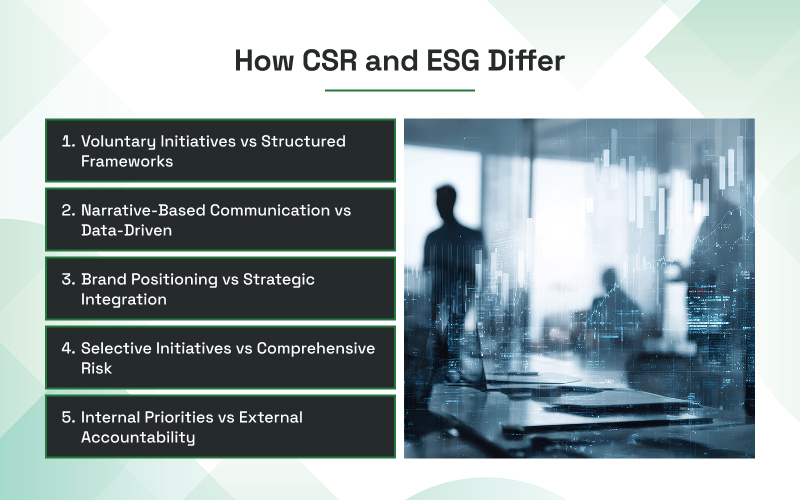
They differ most clearly in how they are planned, measured, reported, and evaluated. CSR often begins with values, while ESG requires systems, data, and accountability. Both can contribute to a stronger corporate sustainability strategy, but in different ways.
1. Voluntary Initiatives vs Structured Frameworks
CSR is typically driven by a company’s internal values and is implemented through voluntary initiatives such as community programmes or sustainability campaigns. These efforts are often flexible and shaped by organisational priorities rather than external requirements.
In contrast, ESG operates within structured frameworks that define what should be measured, how it should be reported, and how performance is evaluated. These frameworks introduce consistency and comparability, allowing stakeholders to assess how effectively a company is managing its environmental, social, and governance responsibilities.
This difference matters because voluntary initiatives may be meaningful but difficult to assess without a consistent system. ESG reporting requirements increasingly push organisations to document policies, track metrics, and explain how they manage sustainability-related risks. This creates a clear difference not only in intent but also in the level of evidence expected.
2. Narrative-Based Communication vs Data-Driven Evaluation
CSR initiatives are often communicated through narratives that highlight a company’s intentions and contributions. While this can strengthen brand perception, it does not always provide a clear basis for evaluating actual impact.
ESG, on the other hand, is grounded in measurable data. Organisations are expected to track key indicators, disclose performance metrics, and demonstrate progress over time. This shift towards quantifiable outcomes enables more transparent and objective assessment, particularly for investors and regulators.
A narrative can explain why an initiative matters, but data shows whether it is working. For example, a company may describe its efforts to reduce energy use, but ESG reporting requires it to show performance trends, targets, and progress. This makes CSR and ESG different in how they build trust with stakeholders.
3. Brand Positioning vs Strategic Integration
CSR is frequently positioned as part of brand identity, helping organisations communicate their values and build relationships with customers and communities. These initiatives may exist alongside core operations but are not always embedded within them.
ESG represents a deeper level of integration. It is incorporated into business strategy, influencing operational decisions, governance structures, and financial planning. This ensures that sustainability considerations are not treated as separate initiatives, but as part of how the business functions and grows.
Strategic integration is especially important when sustainability issues affect costs, operations, supply chains, compliance, or investor confidence. A company that integrates ESG into planning may be better positioned to manage change and respond to future expectations.
4. Selective Initiatives vs Comprehensive Risk Management
CSR often focuses on specific areas of impact, such as environmental campaigns or social outreach programmes. While meaningful, these initiatives may not provide a complete view of the organisation’s exposure to broader risks.
ESG takes a more comprehensive approach by identifying and managing risks that are financially and operationally material to the business. This includes climate-related risks, supply chain vulnerabilities, governance issues, and reputational exposure. By addressing these factors systematically, ESG supports more resilient and informed decision-making.
ESG moves beyond reporting when clear oversight, defined responsibilities, and governance and risk management processes guide sustainability decisions. It also asks whether the company has systems to manage risk, maintain accountability, protect stakeholders, and support long-term resilience.
5. Internal Priorities vs External Accountability
CSR is largely shaped by internal priorities and organisational values. Companies determine which initiatives to pursue and how to communicate them.
ESG, however, is influenced by external expectations. Regulators, investors, customers, and supply chain partners increasingly require transparent disclosures and verifiable performance data. This external pressure drives greater accountability and consistency in how organisations report and manage their impact.
Supply chain requirements, customer due diligence, and market developments also shape sustainability expectations for businesses in Singapore. Companies that adopt clear, measurable sustainable business practices are better placed to meet these expectations. This makes CSR and ESG a business priority, not just a communications topic.
Connecting CSR and ESG in Business Practice
How CSR and ESG Can Work Together
It is more accurate to view the two approaches as complementary. When aligned effectively, CSR initiatives can form the foundation for a more robust and accountable ESG approach.
1. CSR as a Starting Point for ESG Development
Many organisations begin their sustainability journey through CSR initiatives, such as community programmes, environmental efforts, or employee-focused policies. These activities often reflect a company’s commitment to responsible practices, even if they are not initially structured or measured formally.
Over time, as stakeholder expectations evolve, these initiatives can be developed into more systematic ESG strategies. By identifying which CSR efforts are most relevant to the business and its stakeholders, organisations can begin to align them with measurable objectives and integrate them into core operations.
This approach is often practical for companies that are not yet ready for complex ESG reporting. Instead of discarding existing CSR efforts, they can review which initiatives are strategically relevant, what data can be collected, and how outcomes can be tracked. This helps CSR and ESG develop in a more natural and business-relevant way.
2. Translating CSR Activities into Measurable ESG Outcomes
CSR initiatives provide the underlying actions that ESG frameworks evaluate. For example, efforts to improve energy efficiency, strengthen workplace practices, or enhance governance processes can be translated into ESG indicators that reflect long-term performance.
The main difference is how businesses measure these efforts and report their progress. ESG introduces structured measurement, requiring organisations to collect data, define performance indicators, and report outcomes consistently. This process improves transparency and allows stakeholders to assess progress more objectively.
By aligning existing CSR activities with ESG metrics, businesses can move from general commitments to clearly defined and measurable results. This not only strengthens reporting credibility but also helps organisations identify areas for improvement and track long-term progress.
3. Connecting Purpose with Measurable Impact
A key advantage of integrating CSR with ESG is the ability to retain a values-driven approach while demonstrating tangible outcomes. CSR initiatives continue to shape organisational purpose and culture, while ESG ensures that these efforts are supported by data and aligned with business performance.
This alignment also highlights the financial and operational relevance of sustainability. For instance, initiatives focused on resource efficiency can contribute to cost management, while strong governance practices can reduce risk exposure. In this way, ESG acts as a bridge between responsible business practices and long-term value creation.
When CSR and ESG are aligned, businesses can communicate with greater confidence. They can explain not only what they care about, but also how they are constantly acting, measuring progress, and improving.

What Businesses Should Consider
Businesses should decide how CSR and ESG fit their current size, maturity, stakeholder exposure, and reporting needs. Not every organisation needs a complex ESG system immediately, but every organisation can begin strengthening responsible practices. The key is to understand when CSR is sufficient as a starting point and when ESG becomes necessary for accountability.
1. When CSR Is Still Relevant
CSR remains highly relevant for businesses that are focused on building strong relationships with their communities, employees, and customers. It supports brand identity by demonstrating a company’s values and commitment to contributing positively beyond its core operations.
For many organisations, especially smaller or early-stage businesses, CSR provides a practical starting point for engaging in responsible practices without the need for complex reporting structures. Initiatives such as employee well-being programmes, community partnerships, and environmental awareness efforts can help build trust, strengthen organisational culture, and enhance reputation.
CSR also plays an important role in internal engagement. By encouraging employee participation, CSR can help foster a stronger sense of purpose within the organisation. This stronger connection to company values can also support talent attraction and retention, especially as workplace expectations continue to evolve.
2. When ESG Becomes Necessary
ESG becomes essential as businesses grow in scale, complexity, and exposure to external stakeholders. Organisations that are subject to regulatory requirements, investor scrutiny, or supply chain expectations need a more structured approach to managing and reporting their impact.
In these situations, ESG provides the framework needed to identify material risks, track performance, and ensure compliance with evolving standards. It is particularly important for companies operating across multiple markets, engaging with institutional investors, or participating in global supply chains where transparency and accountability are expected.
Besides compliance, ESG also supports better decision-making by linking sustainability considerations to financial performance and operational risk. This allows businesses to move from reactive initiatives to proactive strategies. Meanwhile, stakeholders may request sustainability information for business decisions, making CSR and ESG readiness important for both compliance and commercial opportunities.
Common Mistakes to Avoid When Transitioning from CSR to ESG
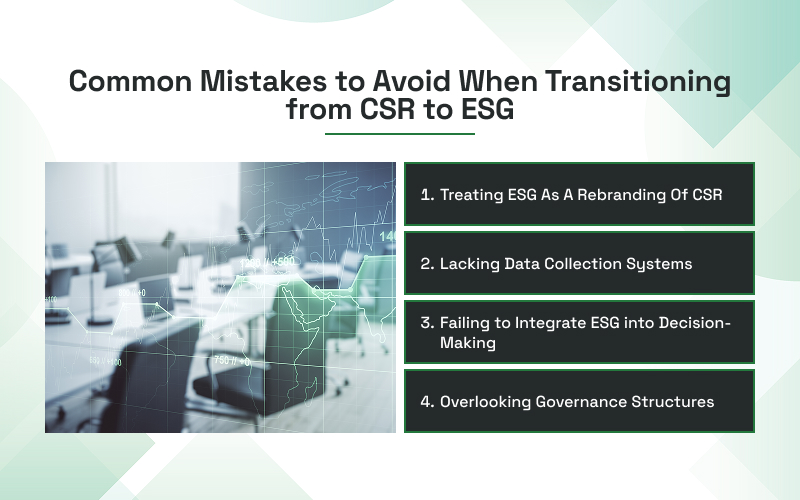
The transition from CSR to ESG requires more than new terminology. Businesses need to develop better systems, clearer accountability, and stronger data practices. Avoiding common mistakes can help organisations build an ESG approach that is credible, practical, and sustainable.
1. Treating ESG As A Rebranding Of CSR
One of the most frequent mistakes is assuming that ESG is simply a renamed version of CSR. While CSR focuses on values-driven initiatives, ESG requires structured frameworks, measurable outcomes, and ongoing reporting. Treating ESG as a communication exercise rather than an operational shift can lead to gaps between what is claimed and what is actually delivered.
This can create reputational and compliance risks. Stakeholders may question whether a company’s claims are supported by evidence. To avoid this, businesses should clearly define objectives, assign responsibilities, and ensure that sustainability claims are backed by data.
2. Lacking Data Collection Systems
ESG relies heavily on accurate and consistent data. Without proper systems to collect, track, and verify information, organisations may struggle to report reliably or demonstrate progress. This can affect credibility and make it difficult to meet stakeholder expectations or regulatory requirements.
Data collection does not need to begin with complex technology. Businesses can start by identifying relevant indicators, assigning data owners, and improving documentation. These processes can be gradually strengthened as reporting needs evolve.

3. Failing to Integrate ESG into Decision-Making
Another common issue is treating ESG as a separate function rather than embedding it into core business processes. When ESG considerations are not incorporated into areas such as strategy, operations, and risk management, efforts remain fragmented and less effective.
Integration helps ensure that sustainability considerations influence real decisions. This may include procurement practices, investment planning, workplace policies, governance reviews, and operational improvements. When CSR and ESG are connected to decision-making, sustainability becomes part of business management.
4. Overlooking Governance Structures
Strong governance is essential for ESG to function effectively. Without clear roles, accountability, and oversight, ESG initiatives may lack direction and consistency. Weak governance can also increase the risk of non-compliance and reduce stakeholder trust.
Addressing these challenges early helps organisations transition more effectively, ensuring that ESG is implemented as a meaningful and sustainable part of business operations rather than a superficial extension of CSR.
Governance structures do not only apply to large corporations. Even smaller businesses benefit from having clear responsibility for sustainability data, approvals, reporting, and risk review. This creates stronger internal discipline and helps ESG efforts remain consistent.
The Future of Responsible Business Practices
The way businesses approach responsibility is evolving rapidly. What was once centred on voluntary initiatives and broad disclosures is now shifting towards measurable impact, strategic integration, and greater accountability. As expectations continue to rise, organisations are expected not only to report their efforts but also to demonstrate how these efforts contribute to long-term performance and resilience. This makes CSR and ESG essential in future-ready business planning.
1. Moving Beyond Disclosure to Measurable Impact
The focus is moving away from simply reporting activities towards demonstrating tangible outcomes. Stakeholders increasingly expect businesses to show clear evidence of progress, supported by data rather than general statements.
This means organisations must go beyond describing what they intend to do and instead track what has been achieved. Measuring impact allows businesses to identify gaps, refine their strategies, and build greater credibility. Over time, this shift strengthens trust by ensuring that sustainability efforts are both visible and verifiable.
2. Greater Integration with Financial and Strategic Planning
ESG considerations are becoming more closely linked to financial performance, risk management, and long-term planning. Rather than being treated as a separate function, ESG is increasingly embedded in core business decisions.
This integration helps organisations understand how ESG factors affect risks, costs, and growth opportunities. It also supports better decisions by aligning sustainability goals with financial outcomes. Finance and accounting teams can strengthen this process through controls, reporting, documentation, and assurance, which is why businesses may involve accountants in Singapore in ESG-related reporting.

3. Evolving Expectations Across Industries
Expectations around ESG are no longer limited to large or listed companies. Businesses of all sizes, including SMEs, are gradually being expected to align with ESG principles, particularly as supply chain requirements, investor expectations, and regulatory frameworks continue to evolve.
For many organisations, evolving expectations create both challenges and opportunities. While structured reporting and data management may add complexity, early preparation can help SMEs strengthen governance, improve efficiency, track key resources, and manage material risks before external pressure increases. By treating CSR and ESG as part of a gradual business improvement process, companies can prepare for future expectations while maintaining operational focus.
Supporting Businesses Through the ESG Transition
As ESG becomes more integrated into financial and operational decision-making, having the right advisory and accounting support is essential. Translating sustainability initiatives into measurable outcomes requires reliable data, strong governance, and a clear understanding of regulatory expectations.
Businesses may also require sustainability report assurance as ESG information becomes more important to stakeholders. Assurance can help improve confidence in reported data, strengthen internal processes, and support clearer communication. Whether a company works with a small accounting firm or a larger advisory team in Singapore, the goal should be to build reporting practices that are accurate, consistent, and useful for decision-making.
Beyond compliance, advisory support can help companies understand what data to collect, how to maintain records, and how to prepare for future expectations. Assurance services can also provide an added layer of confidence when sustainability information is shared with investors, customers, regulators, or supply chain partners. This helps businesses strengthen the link between CSR and ESG while building credibility in a more accountable business environment.
Credo Assurance supports businesses by providing financial guidance, audit expertise, and structured advisory services that help organisations navigate this transition with clarity. Our audit and accounting firm works with both SMEs and larger enterprises to strengthen reporting practices, improve compliance, and align ESG considerations with business strategy.
Frequently Asked Questions
1. Is ESG replacing CSR completely?
No, ESG is not replacing CSR. Instead, CSR and ESG can work together. CSR focuses on values-driven initiatives and community impact, while ESG introduces structure, measurement, and accountability. Many organisations continue to carry out CSR activities, but ESG provides a framework for evaluating and reporting these efforts in a more consistent and credible way.
2. Can small businesses adopt ESG practices?
Yes, small businesses can adopt ESG practices, even without complex systems. They can start by identifying key areas such as energy use, employee well-being, or governance processes, and gradually introduce simple tracking and reporting methods. As expectations from clients, partners, and regulators increase, adopting ESG early can help SMEs stay competitive and prepared for future requirements.
3. Do CSR activities count towards ESG reporting?
CSR activities can contribute to ESG reporting when aligned with measurable outcomes. For example, community programmes, environmental initiatives, or employee policies can be translated into ESG indicators when supported by data and clear objectives. ESG helps formalise these activities by turning them into structured, trackable, and reportable performance metrics.
Conclusion
CSR and ESG are not competing concepts but represent different stages in how businesses approach responsibility and sustainability. While CSR reflects intent and values, ESG provides the structure, measurement, and accountability needed in today’s environment.
Understanding the difference allows organisations to move beyond isolated initiatives and build strategies that support long-term resilience, transparency, and trust. Businesses that align CSR and ESG more effectively can strengthen stakeholder confidence, improve decision-making, and prepare for evolving expectations.
As sustainability continues to influence regulation, investment, procurement, and reputation, companies need to treat responsible practices as part of long-term business planning. With experience supporting a wide range of clients, Credo Assurance’s chartered accountants in Singapore provide practical support across bookkeeping, payroll, financial reporting, and tax compliance. We help organisations support ESG efforts with accurate data, sound governance, and sustainable financial practices.
Contact us to strengthen your reporting processes.