
Financial auditing provides a structured process for checking whether financial information, controls and reporting practices are reliable. This process can span an organisation’s records, systems and internal controls, helping businesses identify risks, verify information and support more accountable decision-making.
As a foundation for organisational accountability and quality assurance, auditing services in Singapore involve on-site verification to ensure compliance with established standards. More than just a procedural formality, auditing is a structured practice shaped by regulatory expectations, professional judgement and the need for transparent reporting.
Audits take on various forms. They may include administrative checks such as document reviews and risk assessments, as well as follow-ups that verify corrective actions. Each type of audit plays a role in identifying inefficiencies, mitigating risks and supporting continuous improvement.
What is Financial Auditing?
Auditing is a key on-site verification activity that covers the inspection and examination of processes or quality systems. Its primary objective is to ensure compliance with established requirements, promoting consistency, efficiency, and accountability. Audits can be applied across an entire organisation or tailored to specific functions, processes, or production steps, depending on the scope and goals of the evaluation.
The Financial Audit Process, Step by Step
Phases of a Statutory Audit Cycle
In this section, we will dive into the phases of a statutory audit cycle. This structured process ensures systematic processes to meet the objectives of auditors and organisations. The key phases are as follows:
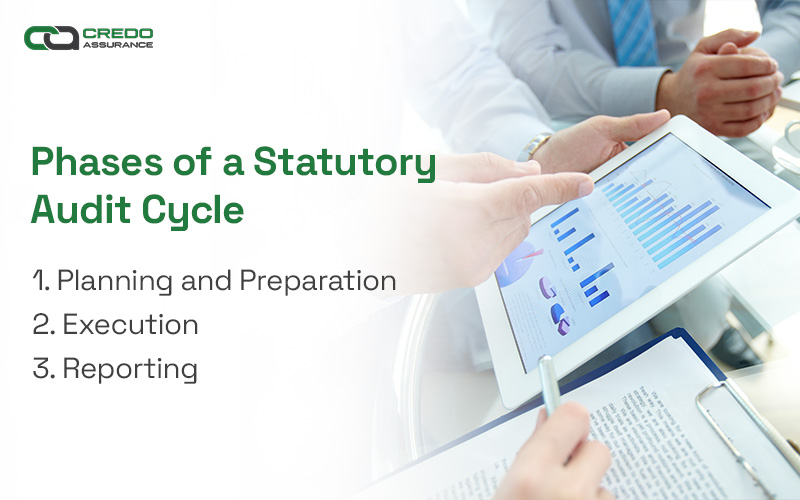
1. Audit Planning and Preparation
The first phase of the statutory audit cycle is comprehensive planning and preparation. This step involves collaboration between the auditor, lead auditor, and audit programme manager to define the scope, objectives, and timeline of the audit. Key activities during this phase include:
- Understanding the organisation’s operations, financial processes, and risks.
- Developing an audit plan that outlines the procedures to be followed.
- Allocating resources, including assigning roles and responsibilities within the audit team.
2. Audit Execution
Once the planning phase is complete, auditors proceed to the execution phase. This is where the actual verification of financial information takes place. This phase is highly detail-oriented, requiring auditors to apply professional scepticism and analytical skills to uncover potential issues or misstatements. During this phase, auditors:
- Examine the company’s financial records, transactions, and systems to assess their accuracy and reliability.
- Verify that the financial reports present a true and fair representation of the organisation’s financial position.
- Evaluate internal controls and identify any weaknesses or discrepancies.
3. Audit Reporting
The final phase of the audit cycle focuses on reporting the findings. Auditors prepare an independent report that provides their opinion on the financial statements prepared by management. The report typically includes:
- Confirmation of whether the financial statements comply with applicable accounting standards.
- Identification of any material misstatements or areas of concern.
- Recommendations for addressing identified issues or improving financial reporting processes.
The financial report audit offers transparency and assurance about the organisation’s financial health and regulatory compliance.
How This Same Process Applies Across Different Audit Scopes
The planning, execution, and reporting cycle above isn’t unique to financial statement audits. In fact, the same disciplined approach underpins operational and compliance-focused audits, just applied to a different scope.
1. Process Audit
Much like the execution phase covered above, a process audit examines whether day-to-day operations are actually followed as documented. It checks whether specific processes operate within defined parameters, such as timeframes, accuracy, approval steps, safety requirements or operating conditions.
In Singapore, this may include Enterprise Singapore-aligned ISO 9001 process audits for manufacturers, F&B operators or service-based businesses that need to demonstrate consistent operational standards. Consistent, well-documented processes also reduce the risk of misstatement, which is a factor financial auditors weigh when assessing a company’s internal control environment.
2. Product Audit
Where the reporting phase confirms whether figures hold up, a product audit confirms whether the finished output does. Product audits assess individual products or services to check whether they meet predefined specifications, quality standards and regulatory requirements.
In Singapore, this may involve SAC-SINGLAS-accredited product certification, or HACCP-related audits for F&B businesses that need to demonstrate food safety controls. Recurring product defects can also surface as inventory write-downs or warranty provisions in financial statements, making product quality relevant to both operations and financial reporting.
3. System Audit
Just as planning sets the scope for a financial audit, a system audit evaluates whether the broader management system is structured to support consistent outcomes. This type of audit looks beyond a single process or product to assess whether policies, responsibilities, controls and review mechanisms work together effectively.
In Singapore, examples may include ISO 9001, ISO 14001 or ISO 27001 audits conducted through SAC-accredited certification bodies. A well-functioning management system is one of the control indicators external auditors assess when forming an opinion on financial statements.

How External Financial Audits Work Under ACRA
Now that you have a clear understanding of the types of audits and their purposes, we will delve into external financial audits governed by the Accounting and Corporate Regulatory Authority (ACRA) in Singapore. These audits help to maintain financial transparency, regulatory compliance, and stakeholder confidence, and support areas like business valuation. Let’s explore their key aspects:
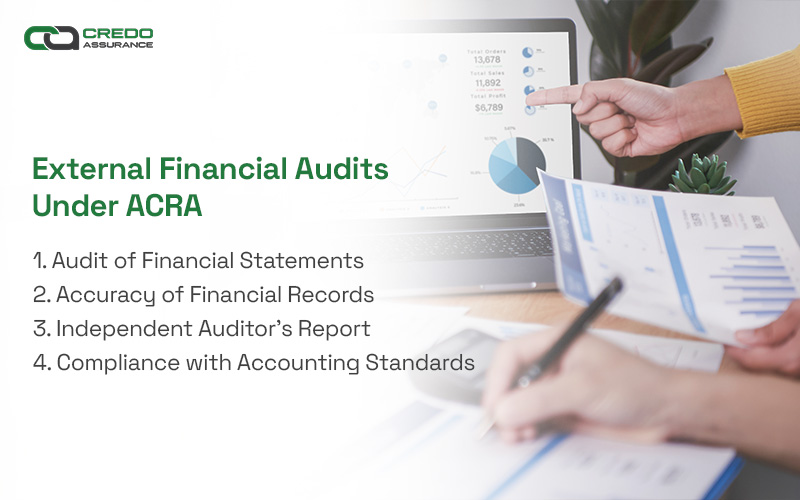
1. Audit of Financial Statements
The examination of a company’s financial statements lies at the core of external financial auditing. The process covers a detailed review of the income statement, balance sheet, cash flow statement, and equity statement. Auditors will ensure documents accurately reflect the company’s financial performance and position. They will also verify compliance with the Singapore Financial Reporting Standards (SFRS) to guarantee compliance with accounting principles and practices.
2. Accuracy of Financial Records
A critical component of the audit process is the verification of financial records. Auditors meticulously assess records to ensure they are accurate, complete, and free from material misstatements. This step is important for identifying discrepancies that may impact decision-making or undermine stakeholder trust.
3. Independent Auditor’s Report
One of the primary outcomes of an external financial audit is the preparation of an independent auditor’s report. This report provides an objective opinion on whether the financial statements present a true and fair view of the company’s financial position. It also highlights any issues or irregularities that require management’s attention, offering actionable insights to address potential risks or compliance gaps.
4. Compliance with Accounting Standards
Ensuring compliance with the SFRS or other applicable frameworks is fundamental to external financial audits. This involves verifying whether the company’s financial statements are prepared in accordance with the relevant accounting standards, promoting consistency and reliability in financial reporting.
By conducting external financial auditing under ACRA, companies not only fulfil regulatory obligations but also enhance their credibility and transparency. These audits assure stakeholders that the organisation is managing its finances responsibly and meeting the highest governance standards.
How Auditing Practices Are Regulated in Singapore
After discovering the intricacies of external financial audits under ACRA, we will now look into the regulatory framework that governs auditing practices in Singapore. These regulations are overseen by the Accounting and Corporate Regulatory Authority (ACRA). Their purpose is to ensure that the process is conducted with integrity, professionalism, and adherence to the highest standards. Here’s the breakdown of these regulations:
1. Registration of Public Accountants
Becoming a registered public accountant in Singapore requires fulfilling stringent criteria to uphold the quality and credibility of audit services. Candidates must possess specific qualifications, relevant audit experience, and membership in the Institute of Singapore Chartered Accountants (ISCA). With this rigorous process, only highly skilled professionals are authorised to conduct audits, reinforcing trust in the system.

2. Monitoring and Compliance
Registered accountants should comply with professional standards and maintain their competence through ACRA’s Practice Monitoring Programme (PMP). This programme encompasses periodic work reviews to maintain adherence to established standards and guidelines. By monitoring compliance, ACRA helps safeguard the integrity of auditor services while encouraging continuous improvement among practitioners.
3. Audit Quality Indicator Framework
To assist audit committees in selecting and evaluating auditors, ACRA introduced the Audit Quality Indicator (AQI) Framework. This framework provides key quality markers, such as the audit team’s experiences, the level of involvement in various financial auditing phases, and other measurable indicators of audit quality.
The AQI Framework focuses on empowering organisations to make informed decisions when appointing auditors. The key is to guarantee precise and reliable financial audits along the way.
The Importance of Robust Auditing Regulations
Besides upholding the professionalism of the auditing industry, the country’s comprehensive auditing regulations and the strict audit requirement in Singapore also foster trust among businesses, investors, and stakeholders. Thanks to the enforcement of stringent registration criteria and assurance of quality evaluation, these regulations and audit certification form the backbone of a transparent and accountable financial ecosystem.
The Future of Auditing in Singapore
The future of auditing in Singapore is marked by innovation and expanded responsibilities. With rapid technological advancements and a growing emphasis on sustainability, the profession is poised for transformative changes that will redefine its role and impact. Let’s discover how this evolution keeps the industry relevant and impactful in an ever-changing world.
1. Technological Advancements
The integration of cutting-edge technologies is revolutionising the landscape. This means auditors will be able to deliver more precise and efficient results in the coming days. Tools like data analytics and artificial intelligence (AI) are the main drivers for this transformation.
Data Analytics
Auditors can now process vast amounts of financial data with ease, identifying trends, anomalies, and potential risks more effectively. This capability not only enhances the depth of audits but also strengthens areas such as forensic audit, where detailed data analysis is crucial. It also generates real-time insights that facilitate quicker decision-making.
Artificial Intelligence
AI-powered systems are automating routine audit tasks such as data entry and reconciliations. They free auditors to focus on more complex areas like risk assessment and fraud detection. At the same time, machine learning algorithms predict potential issues, adding a proactive dimension to the financial auditing process.

By embracing these technologies, auditors in Singapore are well-positioned to meet the increasing demands for accuracy, speed, and adaptability in a dynamic business environment.
Sustainability
Gone are the days when auditors only prioritised financial data. As environmental, social, and governance (ESG) factors increasingly become the central elements of corporate strategy, auditors are taking on a broader role. Today, the verification and reporting of sustainability practices and performance have become a key aspect of modern auditing.
How Sustainability Standards Influence Financial Auditing
Two significant frameworks that will shape the future of sustainability reporting are IFRS S1 and IFRS S2, introduced by the International Sustainability Standards Board (ISSB). These standards underline the growing importance of sustainability in auditing.
IFRS S1
Issued on 26 June 2023, IFRS S1 General Requirements for Disclosure of Sustainability-related Financial Information provides a comprehensive framework for disclosing sustainability-related financial information. It ensures that businesses present clear, consistent, and comparable data on their sustainability practices. The standard becomes effective from 1 January 2024.
IFRS S2
Effective for annual reporting periods beginning on or after 1 January 2024, IFRS S2 focuses specifically on climate-related disclosures. It requires organisations to report on the impact of climate risks and opportunities on their financial position and performance. Notably, IFRS S2 must be applied alongside IFRS S1 to form a holistic approach to sustainability reporting.
In Singapore specifically, SGX has layered its own phased ISSB-aligned disclosure timeline on top of these standards, so businesses may need guidance on latest practices in sustainability reporting and assurance services and what this means for their reporting obligations.

Frequently Asked Questions about the Financial Auditing Process
1. Why is financial auditing important for businesses?
Auditing enhances credibility and trust in financial statements, improves financial management, identifies risks and areas for improvement, and ensures compliance with regulations.
2. How often should a company undergo a financial audit?
The frequency of audits can depend on the size of the company, regulatory requirements, and industry practices. Public companies are typically required to undergo annual audits, while private companies may be audited less frequently, depending on their circumstances.
3. Can companies choose their financial auditors?
Yes, companies can select their auditors, provided they meet the regulatory requirements. It is advisable to choose auditors with relevant experience and qualifications.
4. What’s the difference between financial auditing and a financial report audit?
Financial auditing” refers to the full range of audit types and processes, including regulatory, process, and system audits. A “financial report audit” specifically refers to the statutory examination of a company’s financial statements under SFRS. If you want to learn more, refer to our dedicated guide to the financial report audit process.
Conclusion
Understanding the various types of audits, the structured phases of the audit cycle, and the regulatory requirements in Singapore is essential for organisations aiming to strengthen their financial auditing practices. Each type plays a part in ensuring compliance, enhancing transparency, and supporting business growth. Meanwhile, the entire audit cycle helps organisations gain valuable insights into their financial health and operational effectiveness, while also helping them plan and manage their audit fee in Singapore efficiently.
In Singapore, adherence to the regulatory framework set by the ACRA guarantees that audits meet the highest professional standards. With robust processes, organisations can consistently adhere to local regulations, bolstering their credibility and positioning themselves for long-term success.